
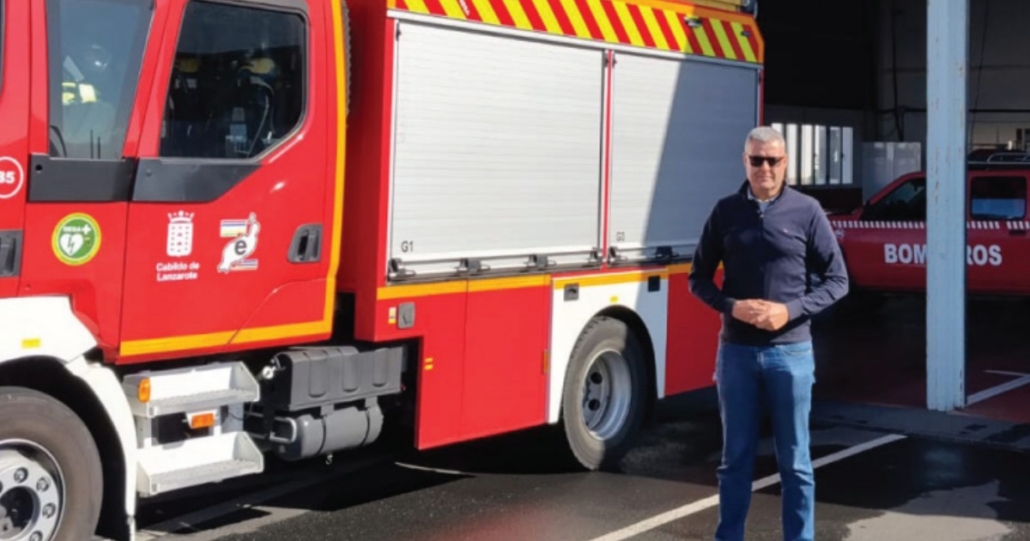
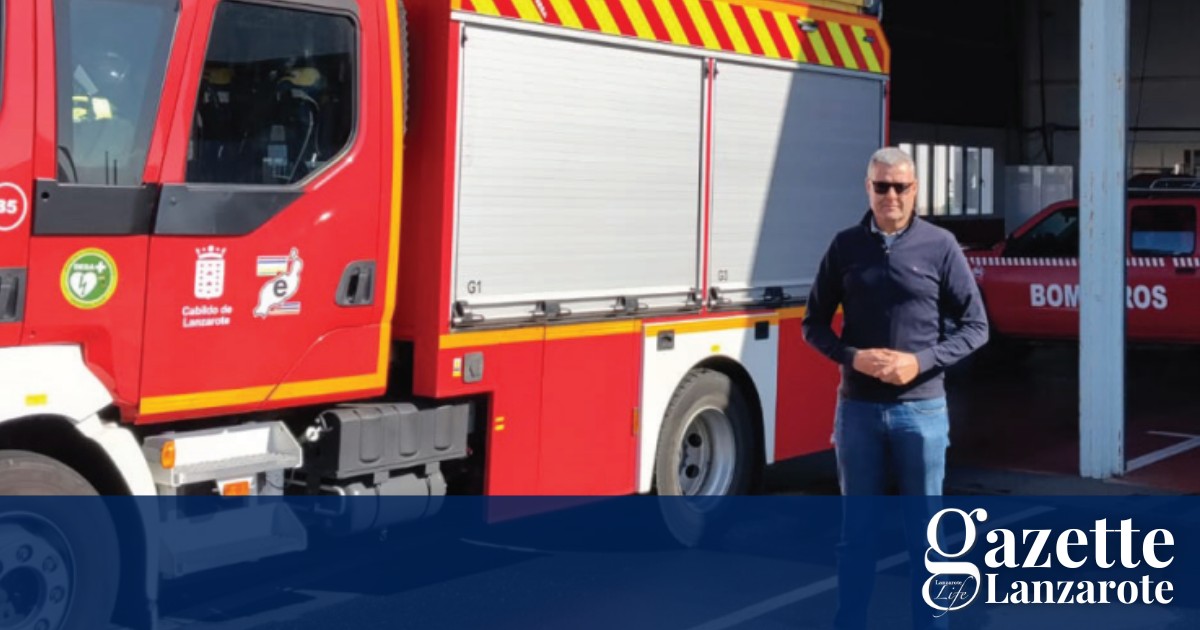
Lanzarote’s main fire station, or Consorcio Insular de Emergencias (Island Emergency Consortium) is located in northern Arrecife, a few streets away from the hospital. Outside the building are a row of shiny, brand new fire engines, a jet-ski and a recently-installed metal tank with a winch that will be used to thoroughly extinguish fires in electric vehicles.
Not everything is brand new, however. There are also several twisted car wrecks piled up against a wall, which are used for firemen to practice their skills at extracting accident victims from vehicles. Inside the building, various firemen are performing maintenance duties on the equipment, and two shiny fireman’s poles leading from an first-floor room (“We don’t use those much these days,” a fireman tells me).
In the offices of an adjoining building we speak to Kiko Aparicio, the Cabildo’s Councillor appointed President of the Emergency Consortium, about emergency provision on Lanzarote.
How many staff does the consortium employ?
Currently it’s 49, with 23 firefighters including two permanent posts on la Graciosa. Ten more firefighters will be incorporated next year.
The island has more tourists than ever. Does this contribute to more emergency calls?
In terms of road accidents, not really. We post photos of most accidents and you’ll notice that not many of them are hire cars, certainly not in relation to the size of the fleet. Traffic accidents usually involve residents.
There are constant reports of mountain rescues. Is this an increasing problem?
There are more people on the island all the time, and so there’ll be more emergencies. First of all, everyone is responsible for their own actions. That applies in all cases, whether it’s climbing a mountain in inadequate gear or speeding on the motorway. Nevertheless, our Island Emergency Plan (PEI) is activated whenever there are situations that could cause risk to the civil population, such as bad weather or heatwaves, and we’ll attend all incidents where we’re needed.
Who pays for those rescues?
Every rescue costs money, and every accident must be paid for. It works just like a car accident, with insurers covering costs. That insurance could be a private policy or social security, depending on the persons involved and the activity.
Is the number of fires on Lanzarote increasing?
Yes. You must have seen the news articles about the arson attacks on containers, which is a persistent problem. However, it’s burning cars that worry us more because of the effect they can have on other vehicles. Many of those cases are deliberate, perhaps as a result of score-settling – they put a barbecue lighter block in the glove box.
Are the firemen at the airport under your command?
No, they’re employed by AENA, the Spanish airport authority. We’ll offer mutual support when necessary but it doesn’t happen often.
The firemen at Arrecife have won a few awards in recent years, haven’t they?
Our firemen were named the best technical team in the world at the World Rescue Challenge in Portugal in 2024 and came third overall in the competition, which dealt with speed and efficiency in freeing people from crashed vehicles. We have the equipment and skills to get people out of crash sites quickly and safely, and this has undoubtedly granted life to many people.
There appear to be some pretty new vehicles already outside. What are they?
There’s a new fire engine that cost eight million Euros and has a ladder that can reach higher than anything we’ve had before – up to 32 metres. There are smaller fire tenders, smaller fire trucks, a dirigible lifeboat and a jet ski.
What are future plans of the emergency services on the island?
We’ll have a budget of nine million Euros to work with in 2026, the highest ever. Most of that goes on wages, but more than two million will be spent on new vehicles such as jetskis and money will also be used to buy land when we relocate the fire station. The plan is to move the fire station to a site opposite the hospital which allows us more rapid access to Arrecife’s ring-road and the San Bartolomé road. Development in the Argana area means that roads are often congested, and every minute can save lives.
Aside from that, there are greater investments to be made in the general arrangement of emergency services on the island. At the moment, we’re working on a plan of four fire stations linking the whole island – one in Haría, the main one in Arrecife, one in Tías and moving the one currently located in Uga to Playa Blanca, where we can provide a faster response to the greatest population. These arrangements are under way but will take time.
The station in Tías will be particularly important because of the port, the beach, and, of course, the presence of the main tourist resort on the island nearby.


Leave a Reply
Want to join the discussion?Feel free to contribute!