
The migration crisis in Ceuta at the end of July focused the attention of the world on a situation which is already familiar to the Canaries.
On the 30th and 31st of July 2026, around 72,000 young people entered the Spanish enclave of Ceuta on the North African coast. Most of them did so by swimming around a breakwater separating the Spanish territory from Morocco, and at least 100 of them died in the attempt, mostly by drowning.
Ceuta, whose population is 84,000 was quickly overrun, and images of migrants wandering the streets and sleeping rough quickly went global. However, a few days after the influx, the majority of migrants had returned to Morocco after it became clear there was no opportunity for them to stay and even less chance of reaching mainland Europe.
The reaction from many European governments was highly critical of Spain. Italy, Sweden and Denmark called for Spain to be excluded from the Schengen Area, and Italy announced checks on Spanish travellers, despite there being zero possibility of migrants reaching Italy from Ceuta via Spain.
This move backfired when Spain angrily responded by imposing identical checks on Italian visitors to Spain, causing far more inconvenience to Italians given that ten times more of them visit Spain than vice-versa.
The criticisms of Spain focused on a recent Supreme Court ruling that was said to have encouraged arrivals by sea, as well as the Socialist government’s recent amnesty that is aimed at regularising the situation of around a million immigrants. This was described as a “pull-factor” encouraging entry, although the deadline for the amnesty ended last year and there is no evidence that it influenced the influx to Ceuta.
As well as the attacks from EU allies, Spain was also criticised by Donald Trump’s US government, still smarting after Spain refused to allow its planes to use Spanish air bases for the US/Israel attacks on Iran.
Meanwhile, many sources have claimed that Morocco was behind the incident, encouraging crossings and ordering border guards to stand aside. They compare it to the 2021 incident, when 8,000 migrants entered Ceuta in a similar manner. The Moroccan ambassador to Spain later acknowledged that the crisis had resulted from a diplomatic dispute between the two countries, and Morocco was widely condemned for using migrants as a political weapon.
THE CANARIAN ROUTE
Morocco is not a promising place for young people. Unemployment is rampant, agriculture has been destroyed by drought and inequality and corruption are rife. In 2019, King Mohammed VI’s government introduced compulsory military service to “promote patriotism among the young”, a move that was widely seen as an attempt to control dissent and crack down on protests.
Similar, or worse, conditions exist in many African countries, and many migrants from these countries have also made their way to Morocco, hoping for an opportunity to reach Europe.
Without a visa, which is almost impossible to obtain, there are only three ways to do so: across the Strait of Gibraltar, over the Mediterranean to the Balearic islands or over the Atlantic to the Canaries.
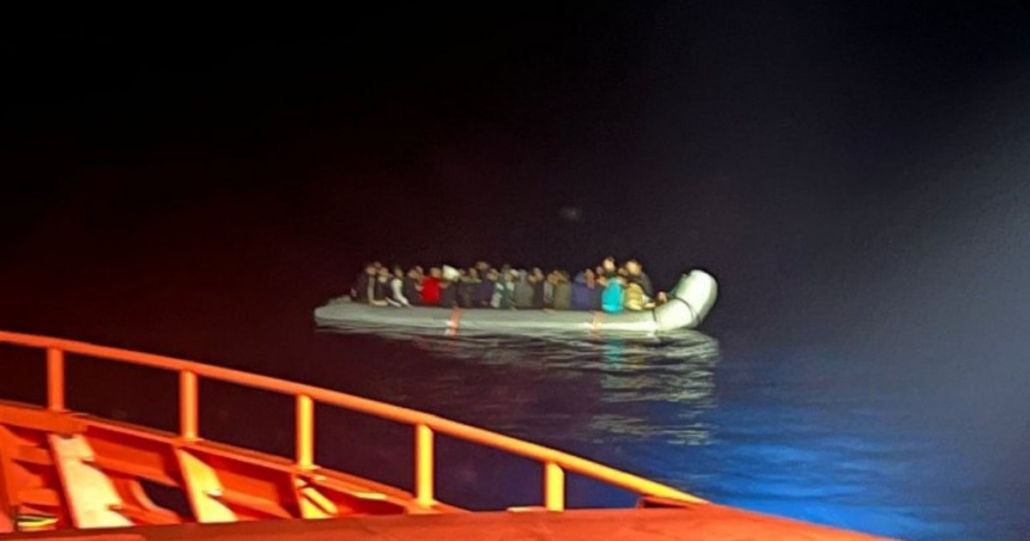
The Canarian route is by far the most dangerous of these, involving a long sea journey in small wooden boats or inflatable dinghies. While the shortest distance between Africa and the Canaries is 95 kms, many take much longer voyages of up to 2,000 kms.
Many thousands of migrants have drowned at sea – at least 1,300 this year alone, according to the Caminando Fronteras charity. However, many more have arrived or been intercepted in Canarian waters.
Nevertheless, the Canarian route is currently less popular than it has been for years. This year has seen a dramatic drop of 60% in the number of arrivals to the Canaries, and last year saw a 40% drop compared to 2024.
But Ceuta shows that this situation can change quickly, and the Canaries has consistently called for more help from the state to deal with irregular migrants by providing funds or projects to cope with the influx.
On Lanzarote, for example, male migrants are processed within 48 hours in tents located on Puerto Naos. Afterwards, they are transferred to larger centres on Gran Canaria, or sent to the mainland to await the result of asylum claims. Women and children are taken to separate centres and children without parents or guardians will become the responsibility of the Canarian Government.
Very few will eventually remain on Lanzarote, but the island, and the rest of the Canaries, will continue to offer hope to desperate people.
On his historic visit to the Canaries in June, Pope Leo XIV pointed out the essential tragedy behind migration, saying “While there is a right to seek refuge when life is threatened, there is also a right not to have to migrate: the right to remain in one’s own home without hunger, war, persecution, violence, the earth becoming uninhabitable, corruption stealing the bread of the poor, or weapons destroying the future of children”.







Leave a Reply
Want to join the discussion?Feel free to contribute!