
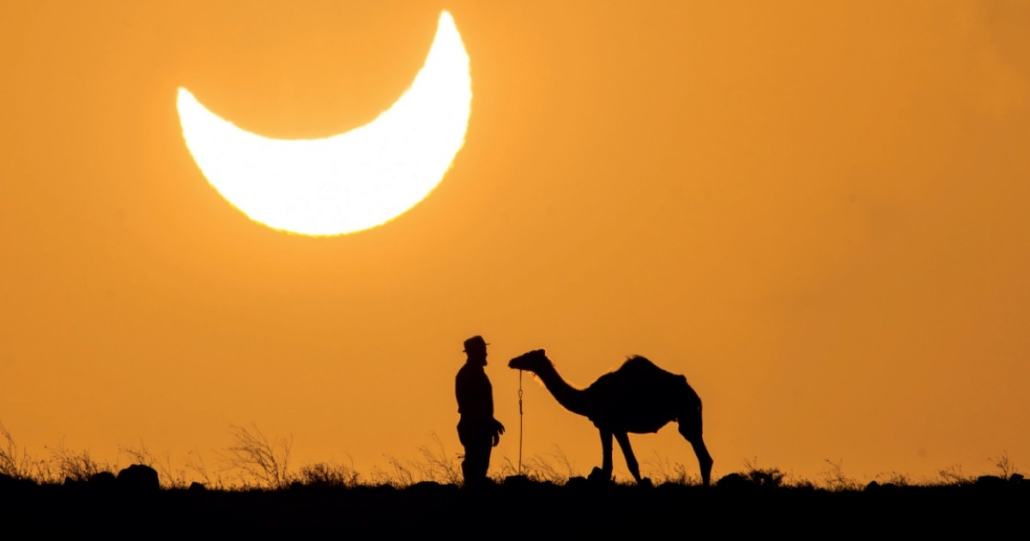
Magec is the ancient Canarian name for the sun. It means “one who possesses brilliance and splendour”, and reflects how the earliest inhabitants of the islands worshipped the sun as a deity.
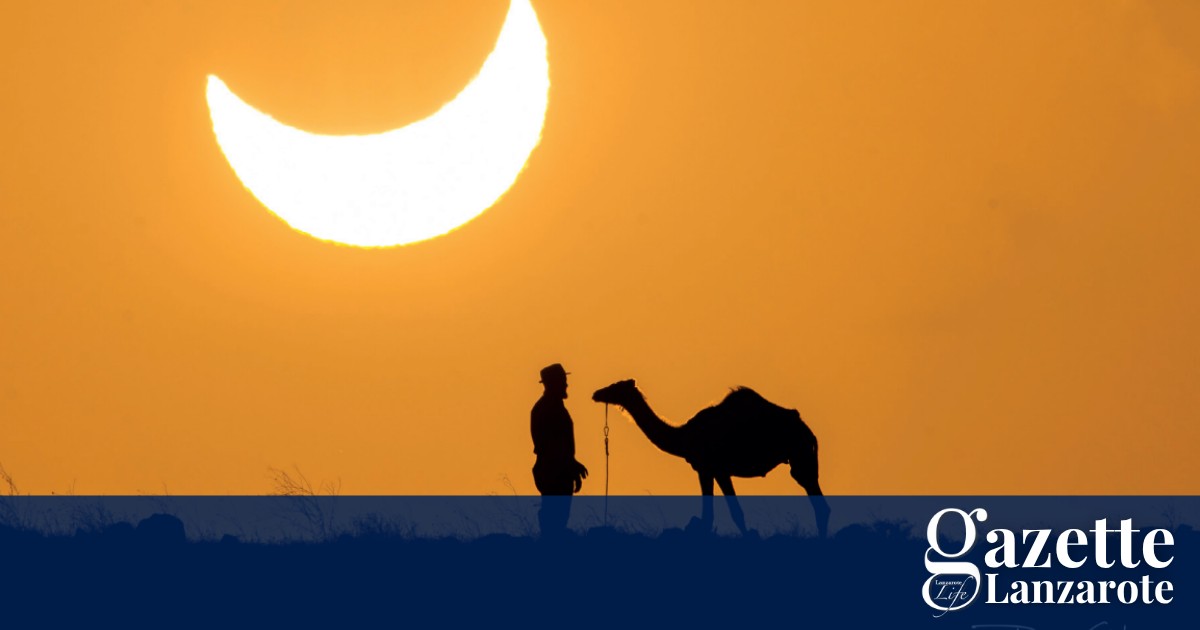
On the evening of August 11th, Lanzarote once again faced Magec as one, this time to see the partial eclipse that covered almost 75% of the sun. A crescent moon happens every month, but a crescent sun only a few times in a lifetime.
People flocked to viewpoints such as the Famara clifftops, Janubio, and El Golfo. 4,000 people arrived at La Santa, where the Elder Science Museum was handing out free eclipse glasses, and had to limit supplies to one pair per family.
But all over the island knots of people gathered quietly on beaches or just outside their homes, facing west or observing the eclipse on mobile phones or projected onto sheets of paper. Conditions were good, with just a hint of calima in the sky and a few straggly clouds that did not obscure the spectacle.
The atmosphere was expectant, but also quiet and almost eerie as the moon slowly passed in front of the sun, lending a strange tint to the evening light. Thousands of people, old and young, huddled closer in their groups, chatting busily, and enjoyed the first solar eclipse many of them had ever seen. A few older locals remembered the eclipse on the Canaries in 1958, the last total eclipse visible from Spanish territory.
Half an hour later it was over as the sun sank behind the volcanoes and the sea and Lanzarote turned away from Magec.
TWO MORE CHANCES
In the days before the eclipse, hundreds of people desperately hunted for the special glasses that would allow them to look directly at it. ONCE lottery kiosks and the Aldi supermarkets soon sold out, and many had to make alternative plans.
But those who were unsuccessful have eleven months to find a pair, as two more eclipses will take place in the next 18 months.
At around 10 am local time on August 2nd 2027, another partial eclipse will be visible from the Canaries. A broad band of mainland Spain from Valencia to Seville will experience totality, but the Canaries are also likely to see an even greater partial eclipse than the one last month.
Six months later, at roughly 6 pm on 26th January 2028, another partial eclipse will be visible. On this occasion the moon will be further away from earth, meaning that in areas where it completely covers the sun there will still be a “ring of fire” around the moon. This is called an annular eclipse, and will only cover a small part of the sun from the Canaries.








Leave a Reply
Want to join the discussion?Feel free to contribute!