
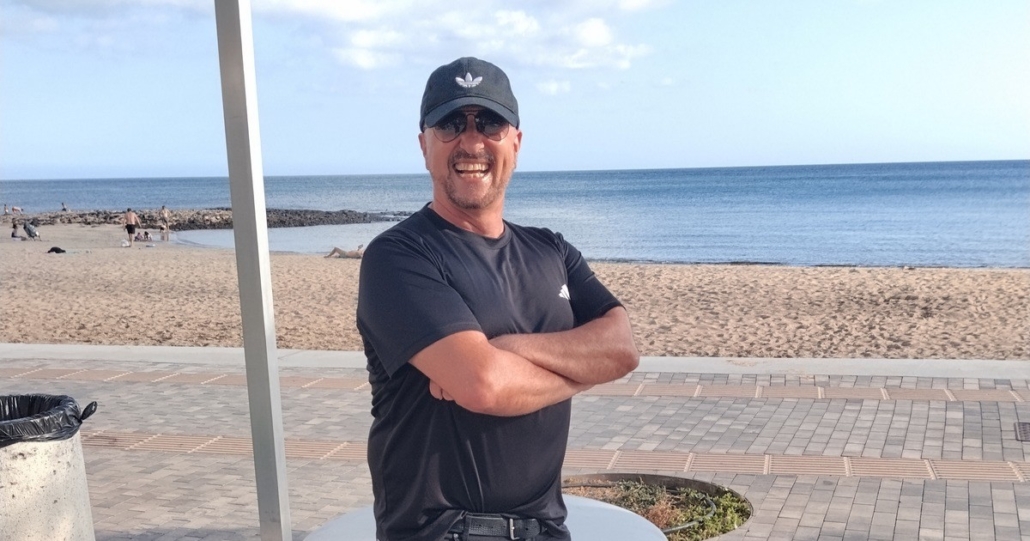
Ginés Cedrés and his band, Los Coquillos, are rock royalty on Lanzarote. Born in Arrecife, Ginés moved to Las Palmas at an early age but spent long summers in the exciting pop scene of Lanzarote in the 1980s. César Martínez spoke to him at Famara last month.
How did Los Coquillos get started?
It’s deeply connected to Lanzarote of the late 80s. You’d see bands in Lanzarote back then—guys wearing earrings and outfits with wild colours, polka dots, fuchsia, yellow… those 80s summers are etched in my mind.
My two older brothers played guitar and made their debut at a fiesta in Uga. In the summer of ’88 some local musicians invited them to some rehearsals, and my brother Miguel asked me to tag along because I played percussion. We spent that whole summer in Arrecife rehearsing and we wrote the first songs that we would later record with Los Coquillos.
At the end of summer, a Lanzarote band Siroco took a liking to one of our songs and won first prize with it at a fiesta the following summer. That made me realize our songs actually worked, so we decided to form our own band with other musicians from Las Palmas.
How did your band’s biggest hit, “Borracho hasta El Amanecer” (Drunk Until Dawn), come about?
Once, after a concert, we went out to a restaurant where a musician was performing. On his keyboard was a sign that read, “We provide music for weddings, baptisms, and communions.” Laughing about it, we said we ought to write a song for those kinds of events. So, we headed to the rehearsal space.
When we arrived, I got a call from my girlfriend at the time and we started arguing. By the time I rejoined the rehearsal, my brother Miguel was already playing a bolero, and our bandmate Chavanel was improvising lyrics about me being drunk and arguing with my girlfriend. That’s how we started crafting the lyrics, set to a bolero melody—a style we’d never played before—with some rhythmic inspiration from Beatles songs like “Ob-La-Di, Ob-La-Da.”
A lot of interesting things happened with this song. In Andalusia, we hit number one on the charts but then stations stopped playing it because it “encouraged alcohol consumption”. However, in the Canary Islands, it was a huge success; it was played on the radio and in every club and party as a closing track.
Then, ten years later, someone played it on Radio Caracol in Colombia and it went to the top of the charts there for a long time, competing with artists like Shakira and Alejandro Sanz. We didn’t even know about it until one day we went online and discovered it was a hit in Latin America. A Mexican group copied the song, and we had to sue them to get our royalties. Later, an Argentine band asked for permission to record it and it was a massive hit there too.
Tell me about your new projects.
During the pandemic, I came up with the idea of covering disco and electronic music from the 80s, 90s, and 2000s—songs by artists like Depeche Mode, Billie Eilish, The Police, David Guetta, Muse, and others—but with a heavy rock-guitar influence layered over electronic backing tracks.
I wanted a female vocalist, and met Silvia Tuñón at a concert; I loved her voice, so I pitched the idea of this new band, “Madafaka All Star,” to her. We spent two years working on the repertoire, arrangements, and rehearsals until we nailed the sound we were looking for. Since July, we’ve been touring festivals and local celebrations across the Canary Islands, and the reception has been fantastic. We even played the San Ginés festival in Arrecife to great acclaim.







Leave a Reply
Want to join the discussion?Feel free to contribute!