
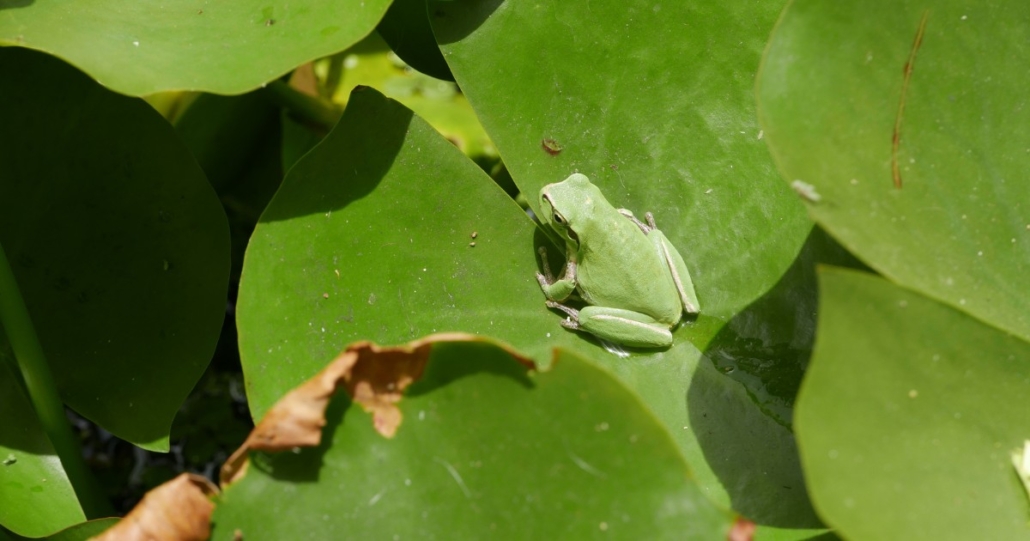
Croaking choruses, annoyed neighbours and impaled corpses – it’s all been going on in David Riebold’s Garden in Haría.
When I planned my garden a few decades ago, a water feature was an obvious addition. However, in a warm climate, an untreated pond can quickly become a breeding ground for mosquitoes, so some sort of biological control is essential.
My initial plan was to introduce fish, but then I learned that Canarian tree frogs had already been established in the reservoir at Mala. I brought back a bucket of frog spawn and within weeks the pond had turned into a dense ‘tadpole soup’, soon yielding dozens of tiny perfectly formed frogs.
It is worth noting that ponds rarely support both fish and amphibians – fish will eat frog’s eggs and tadpoles.
After a few years the frog population expanded dramatically. They appeared throughout the garden and occasionally ventured indoors – a method of insect removal I much prefer to chemical sprays. Although less visible during the summer, their presence was revealed by sporadic calls from the top of palm trees, often getting a reply from a fellow in a neighbouring palm, as if to say; ‘see you at the party pal!’ and what a party they had!
Returning to the pond following the winter rains, the chorus became loud and sustained, I found it atmospheric, but some neighbours did not. One complained that she ‘couldn’t hear her dogs’ – quite why the howls of those rather neglected animals was desired left me puzzled, but objections continued. Someone even poured a tub of bleach into the pond but it had little effect. The only thing that reduced the disturbance was the growth of my trees and shrubs which helped dampen the noise.
That was until a shrike acquired a taste for frog’s legs (and the rest of the creatures). The shrike, now sadly extinct in the UK, remains common in the Canary Islands where it is an efficient predator of insects, lizards and small vertebrates.
It is a lovely bird which looks quite gentle – until you notice the deadly stiletto curving from its upper beak. Unlike most raptors, the shrike lacks grasping claws, so it impales its prey on any suitable spike before feasting in a most indelicate way, earning it the name ‘butcher bird’ (its Latin name Lanius means “butcher”).
For years, a resident shrike frequented the garden, feeding mainly on lizards and large insects. Then, about a decade ago, its behaviour shifted. It began targeting frogs, whose calls conveniently revealed their location. I watched it fly between perch and pond, systematically removing individuals. The effect on the frog population was rapid and severe, and in recent years the garden has been noticeably quieter, much to the neighbour’s relief.
Shrikes evidently find frogs entirely edible, while tougher bits of some prey, such as the heads of lizards, get left behind on spiky plants. Showing an impaled lizard skull to a visiting friend who grew up in Puerto del Carmen got an unexpected response; “Oh! That makes me really happy!”
My puzzlement evaporated as he explained how in the ‘malpais’ behind the strip in Puerto, there was a huge overgrown cactus that scared him as a kid because its spikes were decorated with sun-bleached lizard skulls.
Understanding the role of the shrike had solved a long-standing and unsettling mystery for my friend, who, until then, had imagined that some sadistic child had been catching and decapitating lizards to make that macabre artwork.
Find out more about David’s garden at www.harialanzarote.com









Leave a Reply
Want to join the discussion?Feel free to contribute!