
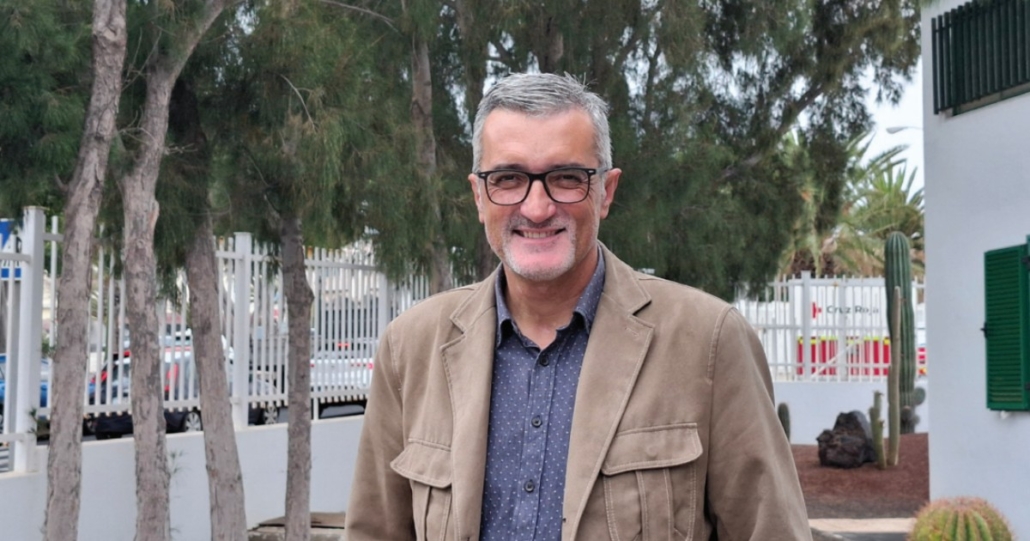
Marciano Acuña is the Cabildo’s Councillor in charge of Social Welfare – a department which covers areas such as the elderly, gender equality, addiction, mental health, disability, children in care and other issues.
Lanzarote’s population is increasing steadily. Is that placing pressure on social services?
There are 170,000 people on Lanzarote. 18,000 of them are over 65 years of age and 17,000 are registered with some kind of disability. We need to provide the services that they require.
We currently have around 1,000 places for social assistance, which range from full-time care to day centres and walkin centres, and we attend around 1,000 people on a daily basis.
We operate on a budget of around €35 million for direct management of care facilities, staffing etc, and a further €35 million goes to a social partnership with NGOs.
How many old people’s homes are there on the island?
Five. There’s the Hospital Insular, Las Cabreras in Nazaret and residences in Tinajo, Haría and Tías. Altogether, they offer 250 beds and a further 250-day spaces.
Is that enough?
No. we need more resources and we need new residences. We’re currently building new centres in Tahiche and in Altavista in Arrecife.
How do you co-ordinate efforts with charities and NGOs on the island?
They’re vital to what we do. NGOs and the third sector have practical experience and knowledge that we can’t match, and that’s why we’re working towards a system of co-governance with them. Previously, the Cabildo provided grants and subsidies on an annually revised basis, but that limits their capacity to plan ahead.
This is why we agreed the Concierto Social (Social Partnership) last year. This allows us to work alongside NGOs such as ADISLAN (special needs), El Cribo (mental health) and AFA (dementia) to manage public places at their facilities. Importantly, it also guarantees funding for seven years,giving these organisations the security they need to make plans.
How does a person access the Cabildo’s welfare services?
First, you have to attend the social services department of your Ayuntamiento. Once there, it’s necessary to apply for assessment under the Dependency Law. Once that’s done, we make the decision to classify the level of dependency according to a points system, for example Grade 1, 2 or 3. Once graded, you can be considered for services such as day care, home help etc.
What are the guidelines you use?
There are several, but an important element at the moment is the idea of de-institutionalisation. This stems from the European initiative to focus on smaller facilities, rather than large institutions, with a preference for home care. We think it’s best to remain at home for as long as possible, and care is easier in smaller facilities.
An example is the way we’ve moved children in care to smaller homes. When they were kept at the hostel in La Santa, there were problems, but now they are distributed in seven smaller centres, things are much better.
There have been complaints that the current amnesty for irregular immigrants will place pressure on social services. Do you see that as a problem?
Not at all. We’re expecting between 2,000 and 3,000 to apply on Lanzarote, and these are all people who are already living on the island. Most of them are of working age, and the amnesty will allow them to contribute and access the system correctly.
What about foreign residents? The British Embassy, for example, has urged British expats to register on the padrón in order to make use of social services.
A foreign resident here has the same rights as a local and should receive the same treatment. That’s been the case for a long time. They pay taxes, have the right to vote in council elections and participate in our community, and have the same rights to use facilities.
Has there been an increase in gender violence?
In the past it was swept under the carpet, a result of a society where women were encouraged to take a submissive role. What has happened is that the issue has become more visible. We attended more than 400 women last year.
Are things improving overall, would you say?
All societies change, and change brings benefits as well as disadvantages. An example of the benefits is the inclusion and acceptance of, for example, the LGBTQ community, and awareness of disabilities. Lanzarote’s Cabildo recently reached the finals of the European Capitals Awards for Inclusion and Diversity, and we’re very proud of that achievement.
But there are also disadvantages. Technology, for example, has meant that we now have to tackle addictions to gambling and mobile use. Gambling has been called “the heroin of the 21st century”.
Any final message? Lanzarote is an island with a clear calling to be as inclusive as possible. All of us who live here are part of the same thing, and we need to care for each other, defend what we have and create a community.






Leave a Reply
Want to join the discussion?Feel free to contribute!