
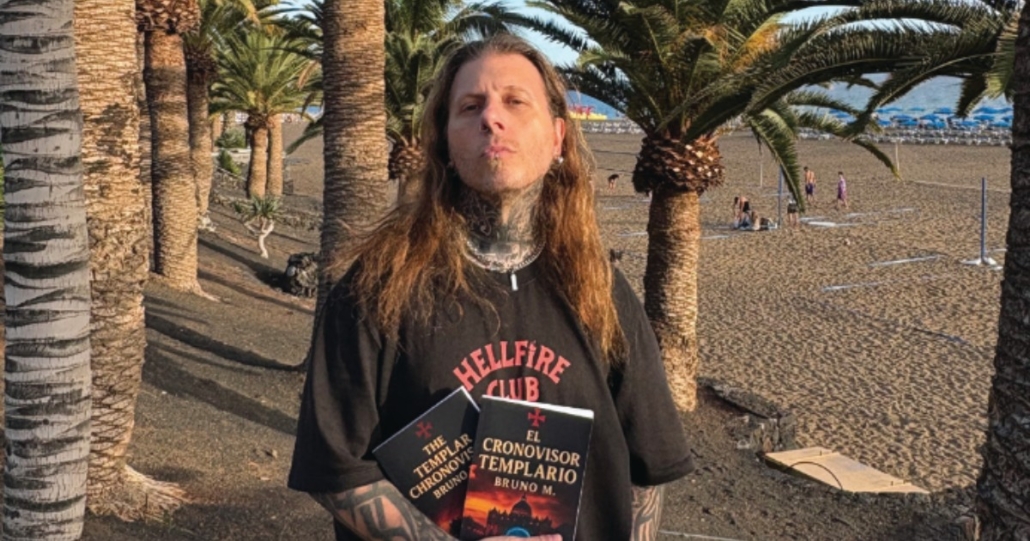
The Templar Chronovisor is the first novel by Bruno M., an Italian writer who has lived on Lanzarote for 11 years. A fascinating journey through space and time, in the tradition of bestsellers by Dan Brown and Ken Follett, the novel is the first part of a trilogy and is partly set on Lanzarote. We chatted to Bruno last month.

Can you tell us a bit more about the book, Bruno?
The Templar Chronovisor is primarily a historical thriller with strong philosophical and speculative elements. I didn’t want to write pure science fiction, nor a classic crime novel. Instead, I aimed to create a story where the reader constantly wonders: “Is this really impossible… or just unexplored?”
What is the chronovisor?
The chronovisor is inspired by the real historical theory attributed to Father Pellegrino Ernetti, who claimed that the Vatican had developed a device capable of observing past events.
In the novel, it becomes a symbolic and narrative device: not just a machine, but a metaphor for humanity’s obsession with understanding time, truth and origin. It represents our eternal desire to look behind the veil of history — and the danger of doing so.
Why did you choose Lanzarote as a setting? What elements of the island inspire you?
I live here, and that allows me to write daily life with absolute authenticity – the light, the silence, the rhythm of the streets, the pubs, the conversations, the atmosphere.
My characters move through spaces that I know. They walk the streets I walk. That gives me the possibility to describe every detail as if I were inside the scene myself, not observing it from outside.
But Lanzarote also carries something deeper: it feels ancient, raw, volcanic, suspended between beauty and desolation. That contrast perfectly reflects the psychological tone of the story.
It seems strange that a book grounded in history is set in Lanzarote, where little history exists before 1402. Was this a conscious choice?
Absolutely. The lack of documented history before 1402 is not a limitation; it is an opportunity. Silences in history are often more powerful than facts.
Where official documentation stops, imagination, oral tradition and speculation begin. That gap allows me to explore themes such as lost knowledge, forgotten civilizations and alternative interpretations of the past, while still grounding everything in plausibility.
What novels, films and other works serve as your inspiration?
In literature: Edgar Allan Poe, for psychological tension and distorted perceptions of reality; Baudelaire, for the aesthetics of darkness; Dante, for the idea of journey as knowledge; and Manzoni and Foscolo for moral depth and memory.
Cinema strongly shapes my style: I write in a cinematic, visual way, inspired by directors like Tarantino. I don’t want the reader to “read” the book. I want them to see it.






Leave a Reply
Want to join the discussion?Feel free to contribute!