
The Canaries should be an ideal place for the e-car revolution, with short distances, huge potential for renewable energy and no tax on new electric vehicles. However, up until now take-up on the islands has been slow compared to the rest of Spain.
Nevertheless, recent rises in the price of petrol and the arrival of affordable Chinese models are likely to spur renewed interest in electric vehicles. David Riebold shares his experience.
About six years ago some friends called, telling me that they had just bought an electric car, but had been called home suddenly – would I look after the car while they were away?
The slight hesitation I felt about being responsible for such an unfamiliar and fairly expensive car (a VW e-golf) evaporated as soon as I got behind the wheel. It was smooth, silent, odourless, with breathtaking acceleration, and charging with cheap overnight electricity cost a fraction of the price of petrol.
I was so delighted I expressed my enthusiasm on social media and was taken aback by the hostility of some responses. Someone I had known for 50 years even unfriended me, showing how emotionally charged the subject has become;
‘Lithium mining is destroying Chile’, ‘The battery will fail – or explode!’ – A quick search suggested to me that these fears are often wildly overstated, and I found myself wondering how such misconceptions can become so widespread — perhaps because established interests have every reason to slow down change.
Electric cars have been around long enough for such extreme criticisms to have faded, but a couple of valid objections remain – e-cars have a limited range and longer refuelling times. However, we live on a tiny island – a return drive from Órzola to Playa Blanca and back is well within the range of the battery.
Another objection was price: driving my friend’s VW made me want an electric car but I was quite unable to afford one.
Although an electric motor is much simpler, more reliable and vastly more efficient than a heat engine, small production volumes have prevented economies of scale. In the last few months, however, this has changed. Affordable e-cars are here!
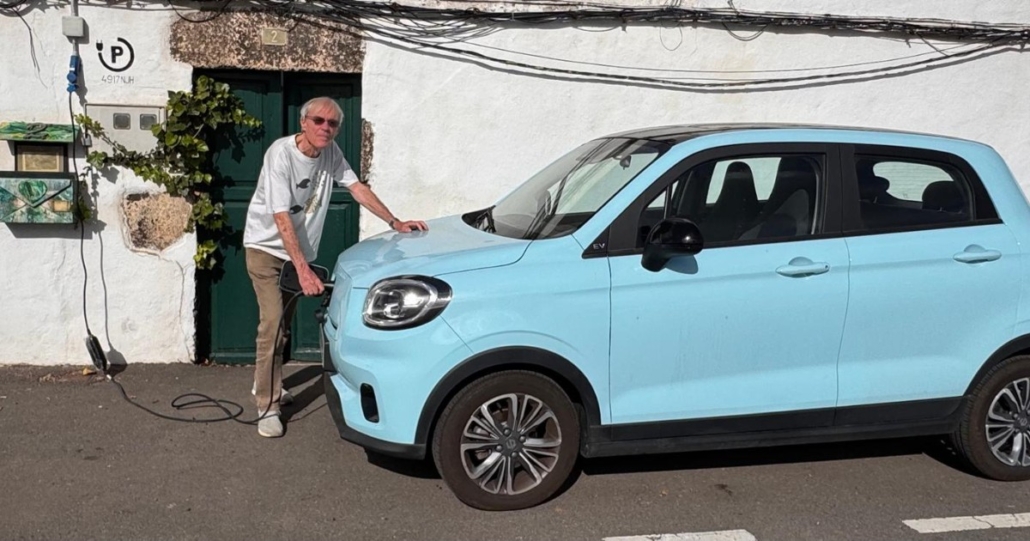
Some friends who know more about cars than I do bought the cheapest of the new Chinese models. They loved it, even preferring it to a more expensive European equivalent. So, I quickly accepted when I was offered one for just a bit more than 13,000 Euros! Four months later, I am still delighted.
This is not the place for a discussion of the view that the world needs to move away from an oilbased economy as soon as possible, but if you live on Lanzarote the case for owning an e-car on this little island is especially strong.
Charging points are becoming more common and if you have a driveway or garage in your house then charging with cheap overnight electricity is easy – I’m lucky and can park and plug directly outside my house.
What has made the biggest difference for me, though, is pairing the car with rooftop solar. With so much sunshine year-round, the idea of driving on locally generated electricity is very appealing. My own system now covers most of my daytime charging, and the installation was straightforward.
I was intending to get some batteries to store up surplus power for the night but a local expert explained that our electric supply is too cheap to justify that expense. Nevertheless, battery technology is advancing fast and so that may soon be worthwhile.
It will not suit every home, but if you have a suitable roof, it is well worth considering. Even without solar power, the savings can be noticeable; and if you do have it, the economic advantage is irresistible.








Leave a Reply
Want to join the discussion?Feel free to contribute!