
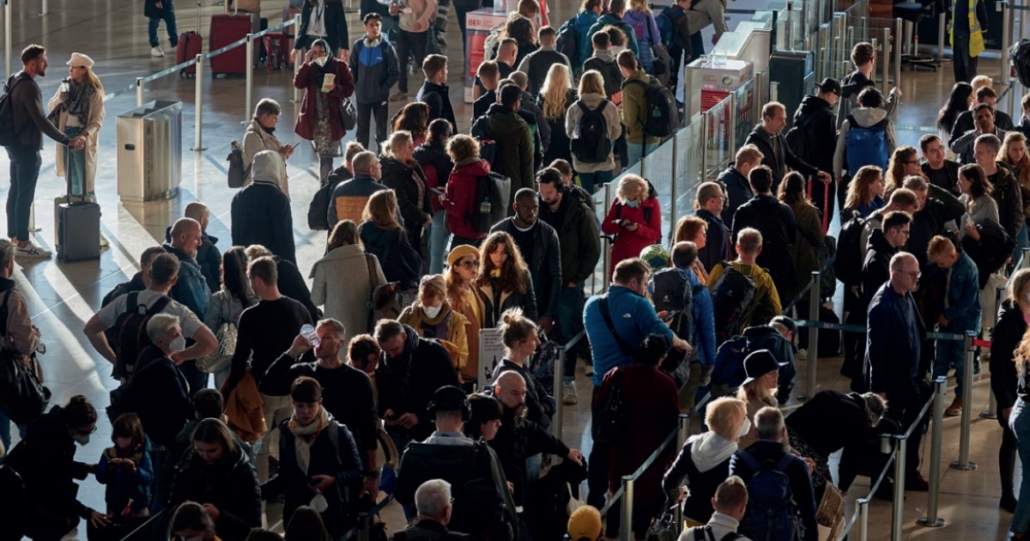
Calls for Spain to suspend the EES scheme that has caused long queues at Lanzarote’s airport have increased following the decision of Greece to halt biometric registration until after summer.

Greece’s decision has prompted calls for other countries to follow suit, with the Canarian PP party recently calling for the Canarian Government to formally request suspension.
Reports that Greece has overtaken mainland Spain in summer holiday bookings from the UK since its decision, and the apparent lack of any EU action against Greece’s decision, has increased speculation that Spain may suspend the scheme. However, no official statements have been made at the time of going to press.
On Lanzarote, problems continue. On 4th May, a Ryanair flight to Edinburgh took off without 70 passengers who had not been able to reach the boarding gate in time due to a failure in the EES system. Ryanair is the only airline to leave large amounts of passengers behind on Lanzarote, and has done so on at least four occasions in recent years.
The EES scheme was introduced for two main reasons. Firstly, immigration control. The vast majority of illegal immigrants are “overstayers”, who arrive conventionally and overstay the 90- day limit established by the Schengen agreement. Until last year, most countries registered arrivals on their national database, but these details were not available to other countries if they crossed a border during their stay. Theoretically, passport stamping should solve this problem, but in practice it is not particularly reliable.
EES creates a database covering the entire Schengen zone, and is aimed at digitally monitoring every entrant from a third country. By the end of March, EES had already detected over 4,000 overstayers – a number that sounds significant but only accounts for 0.02% of the 17 million travellers in that time.
The other main reason for the EES is to speed up border controls, and in this its record has been patchy. While many airports report that the system is functioning well, others have experienced long queues of passengers. The queues are caused by several factors including staff shortages, technical difficulties with the machines and the arrival of several flights in short periods.
Unlike Greece, the Canaries receive tourists all year round and are not likely to be overrun during summer. However, the periodical queues that airports on Tenerife, Fuerteventura and Lanzarote have experienced do not appear to be improving.
A decision to suspend EES, at least temporarily, would be welcomed by tour companies, airlines, much of the local business community and hundreds of thousands of British holidaymakers.








Leave a Reply
Want to join the discussion?Feel free to contribute!