
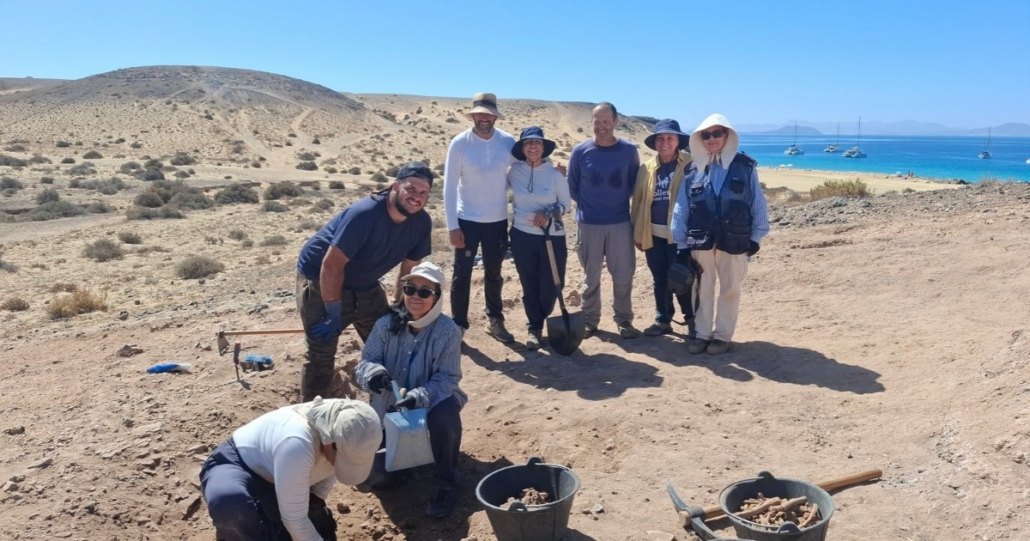
Just a few hundred metres away from the gorgeous beaches of Papagayo, a team of archaeologists are unearthing evidence of one of the most significant events in world history.
Over recent years, the archaeologists Macri González, from the University of Las Palmas in Gran Canaria and Esther Chávez, from the University of La Laguna in Tenerife, have led a series of excavations that is already shedding a surprising light on the very earliest days of the conquest of the Canaries and the birth of the modern age of colonialism.
On the day of our visit, several leisure boats lie anchored just off the shore of Playa del Pozo, the second of the Papagayo beaches as you walk from Playa Blanca. But 624 years ago, very different boats would have been seen, as the French mercenaries Jean de Bethencourt and Gadifer de la Salle put ashore to claim Lanzarote in the name of Spain.
After landing, the conquistadores established a settlement that was gradually expanded over the following decades, and this is what the excavation is focused on. The team are relying on earlier discoveries, their own investigations and historical sources to paint a fascinating picture of the earliest days of the conquest.
The most important of these sources is Le Canarien, the account of the expedition and the early years of the settlement which was written by two monks who acted as chaplains and chroniclers of the 1402 expedition.
THE RUBICÓN SETTLEMENT
The reason for the location of the Rubicón site is four wells containing rainwater from the Los Ajaches mountains. Water was the first essential for any settlement, and the expedition may have heard about the water sources from previous voyagers. Le Canarien also mentions how the French ships brought two slaves from Lanzarote, who may have provided local knowledge and acted as interpreters.
The wells continued to be used almost until the present day. Although some archaeologists believe they are of earlier Roman origin, Macri and Esther are convinced they were built by the conquistadores, and point to masonic engravings as evidence. “Everything here happened within a period of 80 years in the 15th century,” says Esther.
Between the wells and the sea is a hill on which a stone fortress was built. Now long-gone, this structure served as a lookout point, a defensive structure and “a symbol of their presence”, according to Macri. “You have to remember that when they arrived, they knew nothing of the islanders. They settled near the sea so that they could escape easily, and the tower showed their strength.”
Inland from the wells, a wooden cross overlooks the site. This marks the site of the small chapel that was given cathedral status in 1404. The presence of a cathedral allowed the small Rubicón settlement to become the first city on the Canary Islands.
The settlers lived in a European settlement near the fortress, and there are signs of a native settlement closer to the beach. Near the cathedral is a graveyard.
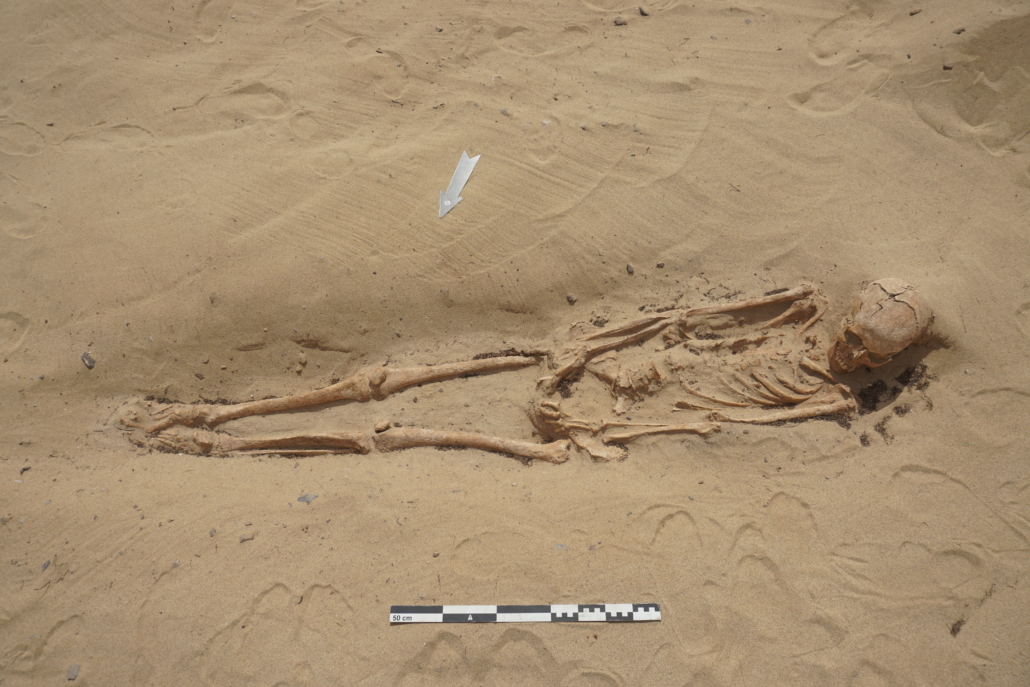
Esther describes the heart-stopping moment in 2023 when, on the last day of the dig, the team located a trail of stones. Investigating further, they found another trail nearby “and then two human feet.”
“We secured the site and took a sample – there’s no way of knowing how old human remains may be at first sight. Later, we established that the skeleton dated from the early 15th century.”
18 skeletons have now been discovered, of men, women, children and new-born babies. They appear to have been buried according to Christian custom, and DNA analysis is underway to establish whether they are of European, Canarian or mixed origin.
On the day we visit, the team is carefully excavating a patch of earth near the aboriginal settlement. Every so often, there’s a cry of “pottery!”, “bone!” or “shell!” as another relic is unearthed.
The bones usually belong to goats, and Macri describes how they have been surprised to discover how much meat the settlers ate. “There are remains of cows, pigs and chickens, as well as goats,” she says. “In Le Canarien, the monks actually beg forgiveness for eating meat during Lent, as it was all they had.”
Each year, once the dig is completed, the team return to their universities to analyse findings. Macri describes her excitement when Patricia, the team’s restorer, called her over to examine a mark on one of the many coins they had found at the site.
“We know from Le Canarien that King Enrique III gave Jean de Bethencourt the right to issue currency, but we didn’t know whether it had ever been done. But we realised that the coin had had a countermark stamped onto it in the shape of gothic letter B. this was proof that the source was correct. They are the oldest countermarked coins in Europe and have attracted a lot of interest from coin specialists.”
This autumn, the team’s main task was to continue to establish the limits of the Rubicón settlement. “There’s still a lot to discover,” says Macri. The ultimate aim is to provide a “photograph” of the earliest days of European settlement on Lanzarote – a process that would extend to the rest of the Canaries and, less than a century later, to the Americas.
The Rubicón excavation is funded by the Canarian Government with the support of Yaiza Ayuntamiento.




Leave a Reply
Want to join the discussion?Feel free to contribute!