
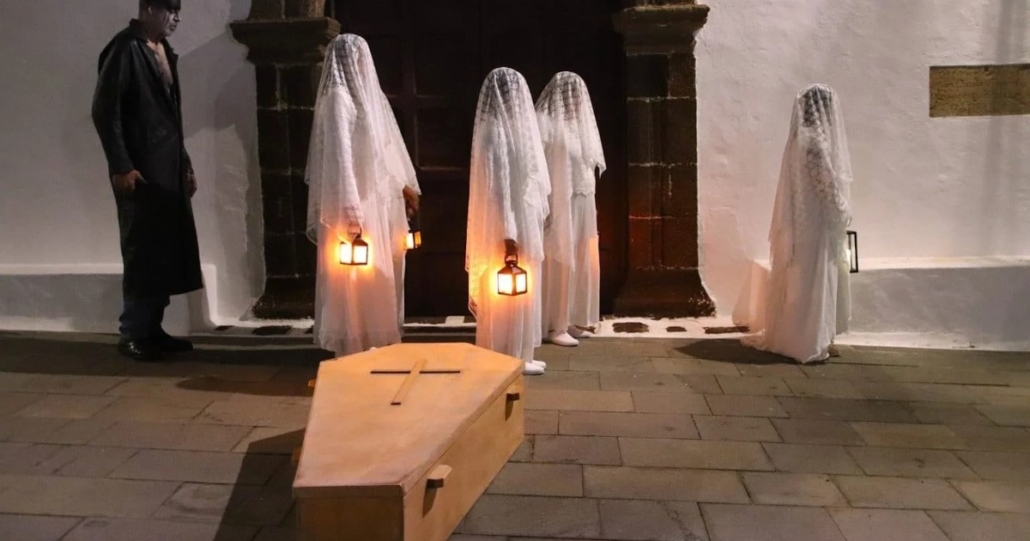
If you’re wandering home after a night out and suddenly see a strange light following you, don’t be afraid. It could just be one of the souls of the dead accompanying you home.
During the Covid pandemic of 2020-21, the master timple player Domingo “El Colorao” Rodríguez filmed a moving tribute to those who had died of the disease, performing a version of the Canarian anthem “Arrorro” alongside his two daughters.
The desolate place chosen for the film was the plain of Mafasca, on Rodriguez’s home island of Fuerteventura, and was chosen for its deep and mystical connection with the souls of the dead, arising from one of the most persistent supernatural legends on the Canary Islands.
That legend is the “luz de Mafasca”, a strange light that has been reported by scores of islanders. This light usually appears to solitary travellers on the plain around nightfall, and hovers in the air, sometimes accompanying them on their journey. The light varies in size, from the size of a tennis ball to a football, and is usually bluish-white.
Legend claims that the lights are the souls of two escaped slaves who burned a wooden cross from a grave to keep warm, but the light of Mafasca is only the most famous example of this type of phenomena, which has been observed on most of the Canary Islands.
They are called the luces populares, or “people’s lights”, as they appear to everyday people. On Lanzarote, most reports of the lights come from the south of the island, and especially the wide plains between Las Breñas and Playa Blanca. However, the celebrated musician Domingo Corujo claims to have seen the light twice off the beach at Playa Fariones in Puerto del Carmen.
Corujo said of the first sighting “When the light grew, it was like a bowling ball, and then it shrank until it almost went out. My wife was puzzled… “So you don’t think it’s a boat…?” I don’t think so. Suddenly, the light, which had been heading towards Fuerteventura, moved in a fraction of a second to the other side, towards Africa. It was so fast that we thought we saw a beam of light. When it got there, it turned around at an angle and made several trips like that. It was incredibly fast.”
The lights are often linked with the souls of the dead, and although many witnesses report being frightened by the way they behave, they are never hostile or aggressive. However, some witnesses claim they have suffered a death in the family shortly after their appearance.
Scientific explanations for the lights have included ball lightning, electromagnetic phenomena caused by volcanic movement or luminescence issuing from rotting vegetable matter, but none of these theories account for the apparently intelligent way the lights move.
All Souls Eve
Halloween is a Celtic tradition that Irish and Scottish immigrants carried to the USA, where it became an important, and increasingly commercialised, event.
But October 31st is also the date of an important tradition on Lanzarote – la Noche de los Finaos, or the Night of the Departed.
November 1st, All Saints Day, is when families traditionally visit cemeteries to pay their respects to the dead, but the previous night is a time when families would gather around the oldest female member and listen to reminiscences and stories about the departed.
These are not ghost stories; they are fond remembrances and a way of passing on family traditions, and the mood is one of celebration as much as of loss. The family would eat dried figs, roasted chestnuts and drink wine during their vigil, and were often visited by travelling folk groups called Ranchos de Animas, who sang a song for the dead in exchange for a small donation.
These groups continued to perform their sombre songs for the dead until December 13th, when their repertoire changes to more joyful Christmas songs. The tradition of Los Finaos has declined in recent years, but can still be found in certain towns, and especially the ancient capital of Teguise.
It’s a custom that harks back to long-bygone days when Lanzarote’s towns and villages moved at a different, slower pace, and one that shows continuity between honouring the dead and preparing for the Christmas celebrations.


Leave a Reply
Want to join the discussion?Feel free to contribute!