


Page 10 - Demo
P. 10
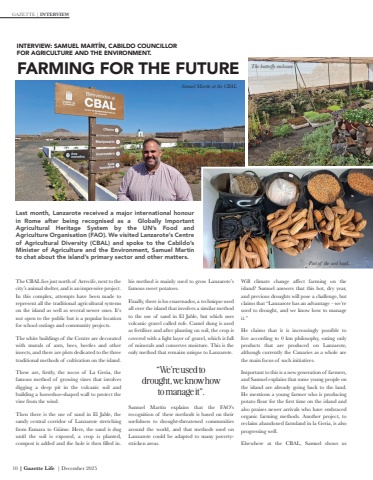
10 | Gazette Life | December 2025GAZETTE | INTERVIEWFARMING FOR THE FUTURE Last month, Lanzarote received a major international honour in Rome after being recognised as a Globally Important Agricultural Heritage System by the UN%u2019s Food and Agriculture Organisation (FAO). We visited Lanzarote%u2019s Centre of Agricultural Diversity (CBAL) and spoke to the Cabildo%u2019s Minister of Agriculture and the Environment, Samuel Mart%u00edn to chat about the island%u2019s primary sector and other matters.The CBAL lies just north of Arrecife, next to the city%u2019s animal shelter, and is an impressive project. In this complex, attempts have been made to represent all the traditional agricultural systems on the island as well as several newer ones. It%u2019s not open to the public but is a popular location for school outings and community projects. The white buildings of the Centre are decorated with murals of ants, bees, beetles and other insects, and there are plots dedicated to the three traditional methods of cultivation on the island. These are, firstly, the zocos of La Geria, the famous method of growing vines that involves digging a deep pit in the volcanic soil and building a horseshoe-shaped wall to protect the vine from the wind.Then there is the use of sand in El Jable, the sandy central corridor of Lanzarote stretching from Famara to G%u00fcime. Here, the sand is dug until the soil is exposed, a crop is planted, compost is added and the hole is then filled in. his method is mainly used to grow Lanzarote%u2019s famous sweet potatoes. Finally, there is los enarenados, a technique used all over the island that involves a similar method to the use of sand in El Jable, but which uses volcanic gravel called rofe. Camel dung is used as fertiliser and after planting on soil, the crop is covered with a light layer of gravel, which is full of minerals and conserves moisture. This is the only method that remains unique to Lanzarote.Samuel Mart%u00edn explains that the FAO%u2019s recognition of these methods is based on their usefulness to drought-threatened communities around the world, and that methods used on Lanzarote could be adapted to many povertystricken areas.Will climate change affect farming on the island? Samuel answers that this hot, dry year, and previous droughts will pose a challenge, but claims that %u201cLanzarote has an advantage %u2013 we%u2019re used to drought, and we know how to manage it.%u201dHe claims that it is increasingly possible to live according to 0 km philosophy, eating only products that are produced on Lanzarote, although currently the Canaries as a whole are the main focus of such initiatives. Important to this is a new generation of farmers, and Samuel explains that some young people on the island are already going back to the land. He mentions a young farmer who is producing potato flour for the first time on the island and also praises newer arrivals who have embraced organic farming methods. Another project, to reclaim abandoned farmland in la Geria, is also progressing well. Elsewhere at the CBAL, Samuel shows us INTERVIEW: SAMUEL MART%u00cdN, CABILDO COUNCILLOR FOR AGRICULTURE AND THE ENVIRONMENT. %u201cWe%u2019re used to drought, we know how to manage it%u201d. Samuel Mart%u00edn at the CBAL.The butterfly enclosure.Part of the seed bank.


